
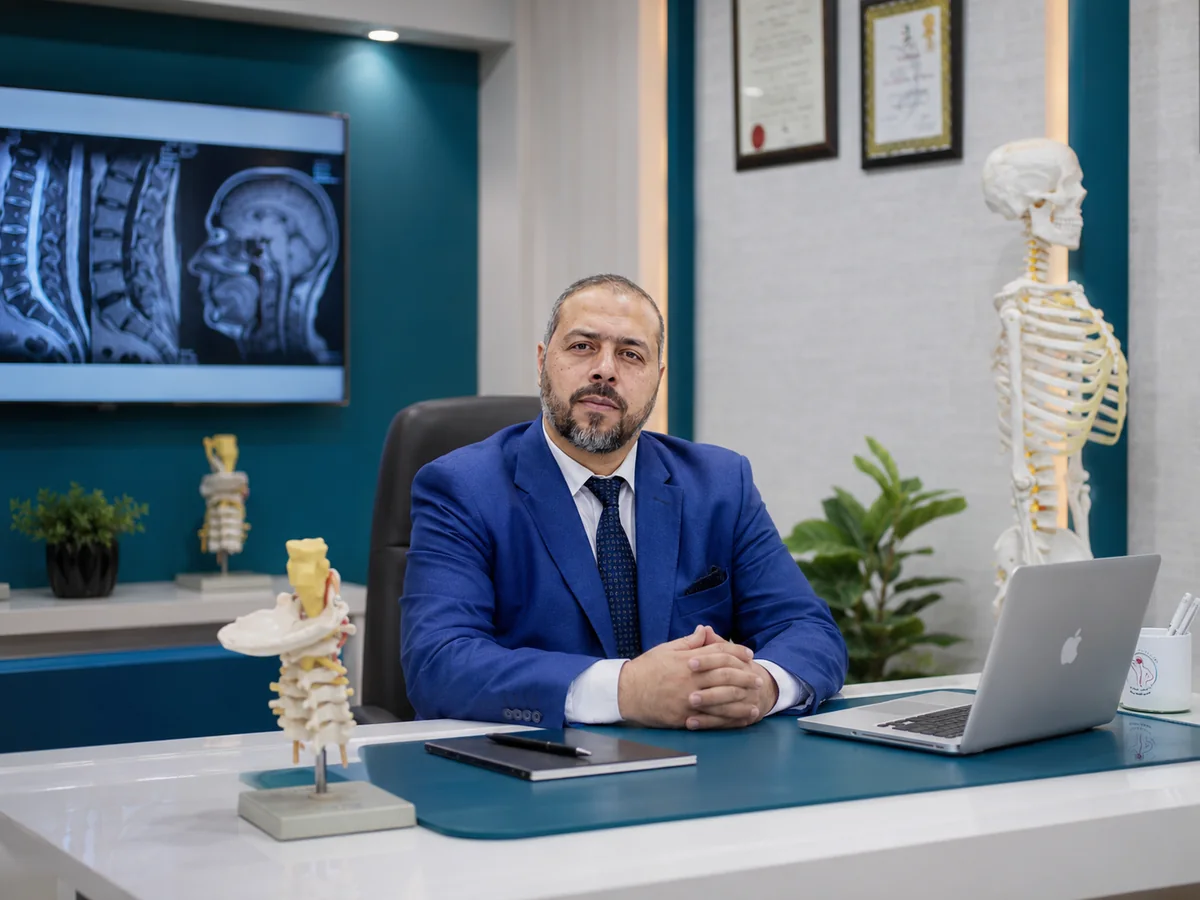
The website of Prof. Mohamed El-Gaidi, in Arabic and English, provides information about the doctor and the Spine Health & Neurosurgery Center in Dokki, Giza, together with educational content on brain, nerve and spine conditions and pain management. It is meant to help you understand your condition and prepare for your visit, not to replace it.
1. Purpose of the content
The content explains terms, conditions and treatment options you may discuss with your doctor. However detailed a page is, its information remains general: it cannot know your age, medical history, medications, neurological examination or the full picture of your scans.
2. No diagnosis through the website
Symptoms such as back pain, hand numbness and headache can have many causes, and scans may show changes unrelated to the complaint. Diagnosis requires a history, an examination and correlation with imaging, which no website can do. Reading our sciatica treatment page, for example, does not mean every leg pain is sciatica.
The booking form and WhatsApp messages are for arranging appointments, not an instant consultation service. The clinic team may ask for a report or give administrative guidance, but medical decisions are not made from a short message or a phone photo of a scan.
3. Mentioning a procedure is not a recommendation
Service pages mention procedures such as targeted injections, radiofrequency ablation, endoscopy, spinal fixation, shunts, neurostimulation and tumor surgery. They describe the scope of the specialty and do not mean a procedure is the first or best option for every patient. Each has indications, contraindications, risks and alternatives discussed at consultation.
The least invasive option is not always the most suitable, and open surgery is not always the riskiest. Radiofrequency ablation, for instance, may relieve pain from a specific nerve but does not treat severe nerve compression causing progressive weakness.
4. No guarantee of results
Outcomes vary between individuals depending on the diagnosis, duration of illness, degree of nerve involvement, age, chronic conditions, smoking, bone health and adherence to instructions. Complete recovery, full pain relief or freedom from complications cannot be guaranteed. Informed consent before any procedure is where the expected result, risks and alternatives for your specific case are explained.
The doctor's qualifications, photos and academic background are shown to identify who provides the information and care, not as a promise of any result.
5. Emergencies
Do not use the website, WhatsApp or social media in an emergency. Call an ambulance (123 in Egypt) or go to the nearest emergency department for sudden weakness of the face, arm or leg, disturbed speech or consciousness, a sudden severe headache, a first seizure, a head injury followed by deterioration, or increasing vomiting and drowsiness.
Urgent assessment is also needed for fever with neck stiffness or neurological decline, loss of bladder or bowel control with numbness between the thighs, or rapidly worsening limb weakness. These symptoms are not always due to serious disease, but delay can affect the outcome.
6. Medications and blood thinners
Do not stop blood thinners, anti-seizure drugs, steroids, or blood pressure and diabetes medication on your own before any test or procedure. Stopping may raise the risk of a clot or seizure, while continuing may raise another risk depending on the procedure. Instructions are given once the drug, dose and reason are known, in coordination with the responsible doctor.
Mention of a painkiller or conservative treatment in an article is not a prescription. Even common medicines can interact with stomach ulcers, kidney disease, pregnancy or other drugs, so ask a doctor or pharmacist who knows your history.
7. Illustrative images
Photos of the doctor and clinic identify the person and place. Some page images are illustrative visuals and do not show the scans or results of any real patient. Do not compare an illustration with your own case or draw a diagnosis from it; the site does not publish patient "before and after" images without documented consent and clear medical context.
8. External links and sources
The site may link to PubMed, ResearchGate, Google Scholar, social media accounts or educational sources. A link does not mean we endorse everything on that site or guarantee its accuracy or availability, and comments on social pages reflect their authors. The findings of any study apply to specific patient groups and conditions and cannot be applied automatically to an individual.
9. Articles and comments
The articles section runs on WordPress and is currently in Arabic. If comments are open, do not use them to request a diagnosis or post reports and personal data. Comments containing sensitive data, dangerous advice or abuse may be removed, and a reply to a comment does not constitute medical follow-up.
10. Arabic and English versions
This English version serves visitors who prefer English. Wording may differ slightly from the Arabic pages without any difference in medical meaning. This disclaimer applies to both versions; you can also read the Arabic version.
11. Your responsibility as a user
Use the content to prepare your questions and understand terms, not to make treatment decisions alone. Keep your reports, scans and medication list, tell your doctor about any new symptom, and ask for clarification of any part of the plan you do not understand. Do not share your medicine or your doctor's advice with someone else because their symptoms seem similar.
Check the website address and clinic number before sending any data. The site never asks for payment card details; if you find a page or account impersonating the clinic, please tell us.
12. Content updates and contact
Pages are reviewed when services change or medical clarification is needed, and the date of the latest update is shown on the pages. If you notice an error or a broken link, let us know so we can fix it. To see how we handle your data, read our privacy policy.
To book or ask a question: contact page, mobile and WhatsApp +20 102 618 6600, or landline +20 2 3335 1513. The clinic is at 114 El-Tahrir St., Dokki, Giza, next to Dokki Metro station, 4th floor.