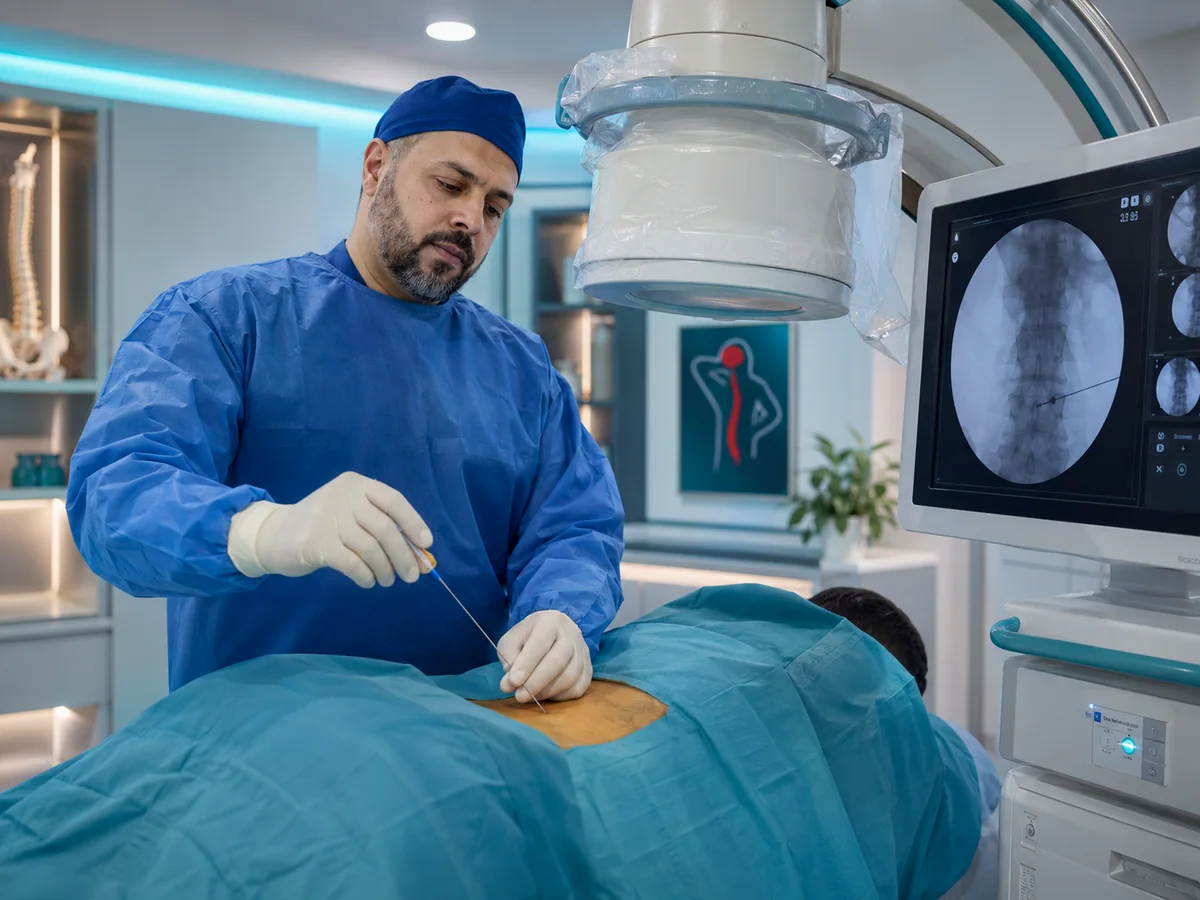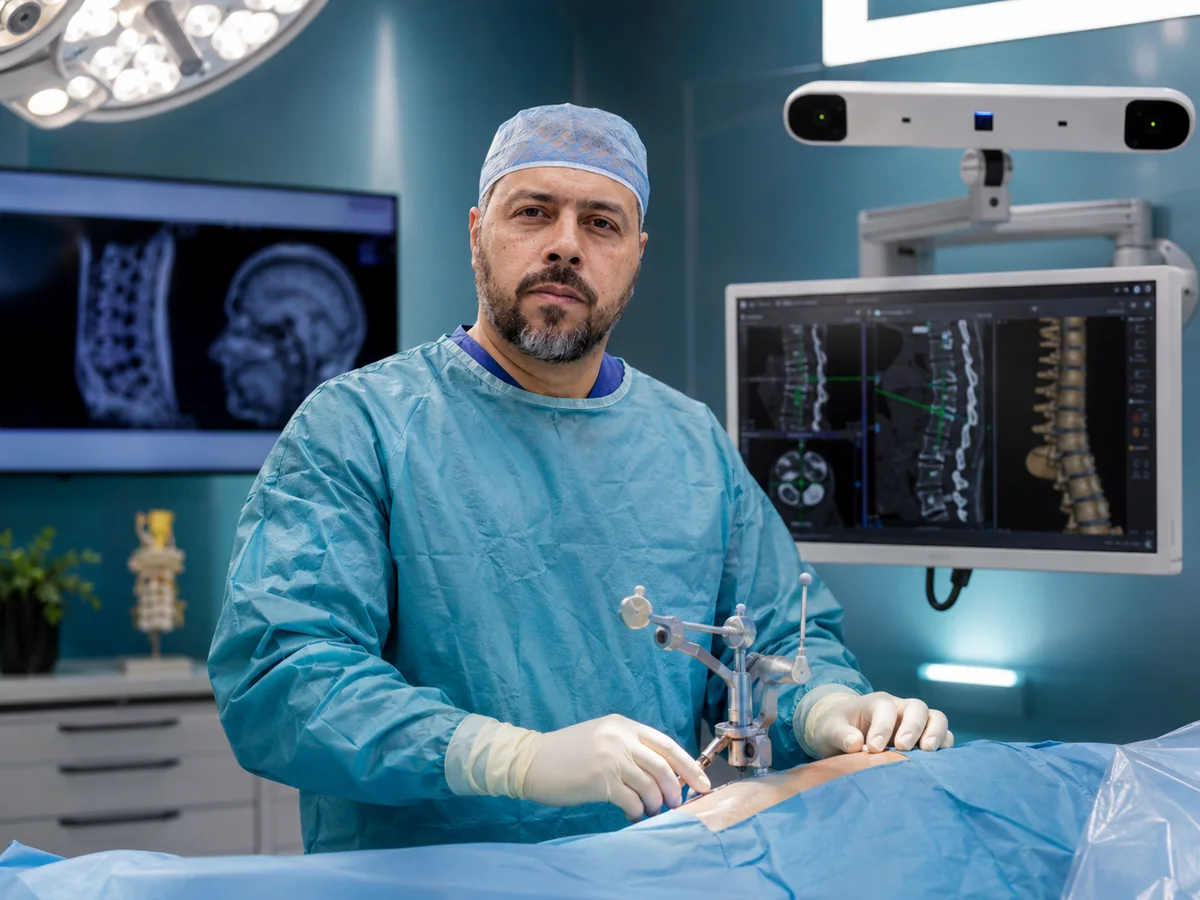
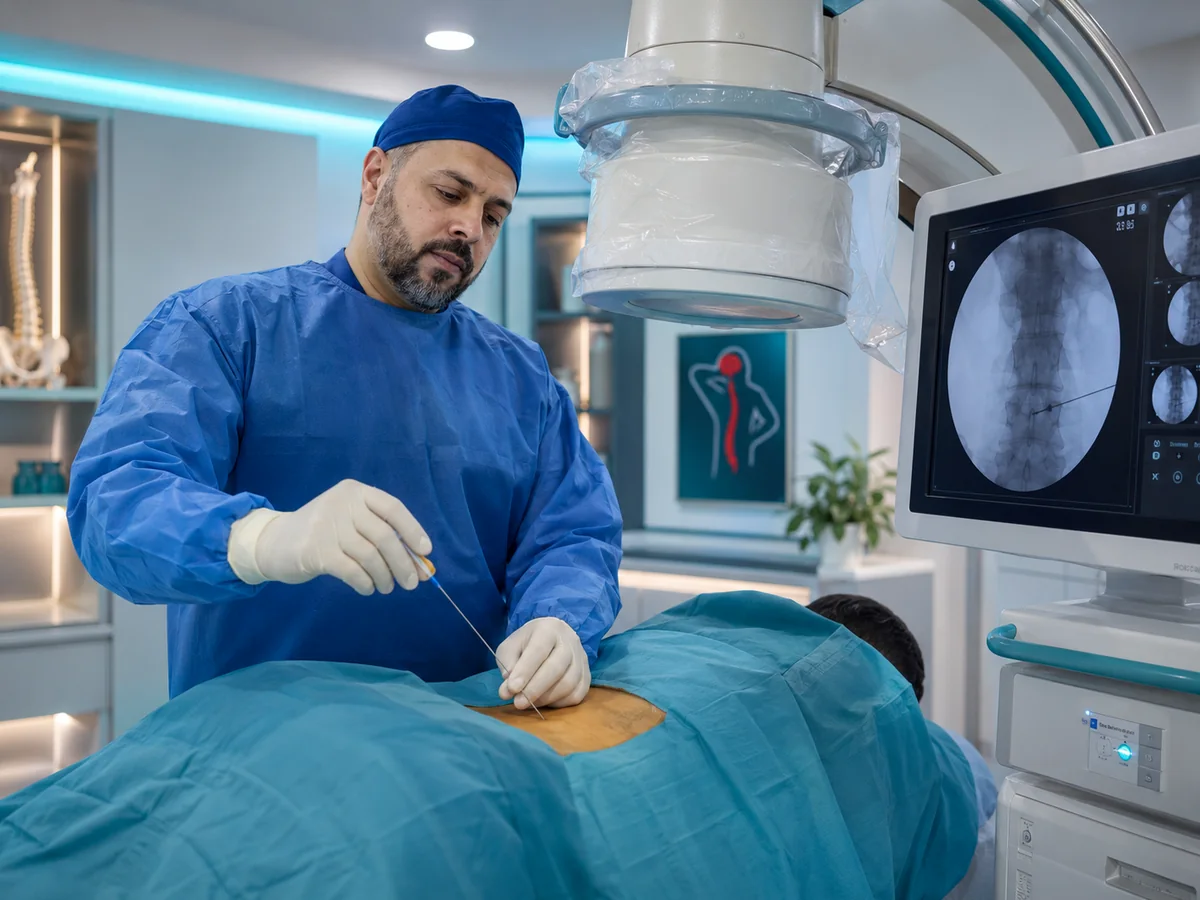
Pain management without surgery means reaching the nerve or joint responsible for your back or neck pain with a fine, image-guided needle, then calming the inflammation or switching off the pain signal, instead of months of painkillers or going straight to an operation. At Prof. Mohamed El-Gaidi's clinic in Dokki, Cairo, every plan starts with one question: where exactly is your pain coming from?
If you have low back pain running down your leg, neck pain spreading to your shoulder and arm, or arthritis in your spine or knee that disturbs your sleep and walking, there is often a minimally invasive option that suits you. Most of these procedures need no incision and no hospital stay.
Where does back and neck pain come from?
Back pain is a symptom with several possible sources, and each one is treated differently. An MRI alone is not enough; plenty of people have a bulging disc on their scan and no pain at all. The neurological exam and the pattern of your pain point to the real source:
A compressed nerve root
Sharp or burning pain down the leg (sciatica) or the arm, often with numbness. Usually due to a herniated disc or a narrowed nerve exit.
The small facet joints
Central back or neck pain that worsens when leaning back, twisting or standing for long, and rarely travels below the knee. Caused by arthritis in these joints.
The sacroiliac joint
One-sided pain low in the back above the buttock, worse climbing stairs or standing on one leg, and often mistaken for a disc problem.
Muscles and trigger points
Painful knots in the neck or back, or a tight piriformis muscle in the buttock pressing on the sciatic nerve and mimicking sciatica.
More than one source can exist in the same patient, such as a lumbar disc plus facet arthritis. The order of treatment matters: we start with the source that affects your life most, then re-assess.
Diagnostic blocks: testing before treating
When the source is not clear from the exam and scans, a small diagnostic injection of local anaesthetic is placed on the suspected nerve or joint. If your pain drops clearly over the next few hours, that confirms the target, and a longer-lasting treatment such as radiofrequency ablation becomes a logical next step.
If the pain does not change, the test has spared you a procedure that would not help, and the search moves to the real source. You will be given a simple sheet to score your pain every hour afterwards, because those notes guide the next decision.
Spinal injections: treating disc pain and sciatica without surgery
This group targets nerve root pain and scar tissue around nerves, and is the most requested in herniated disc and foraminal stenosis cases.
Epidural injections
Anti-inflammatory medication placed in the space around the nerves in the neck or lower back, to settle an irritated root and ease arm or leg pain.
Nerve root blocks
A more precise injection at a single nerve exit, used both to treat and to confirm which root is responsible when a scan shows several problems.
Cervical or lumbar epidural catheter
A thin catheter steered through the epidural space to deliver medication to a specific level, for selected neck or low back cases.
Racz catheter adhesiolysis
For persistent pain after previous back surgery caused by scar tissue around a nerve. The catheter is guided to the scarred area and medication is injected to help free the nerve.
If your buttock pain comes from the piriformis muscle or muscle knots, piriformis and trigger point injections release the spasm and take pressure off the sciatic nerve. Chronic leg pain from an inflamed nerve root may be treated with pulsed radiofrequency; see sciatica treatment for details.
Radiofrequency and cryotherapy for spinal and joint arthritis
Facet joint arthritis, sacroiliac joint pain and arthritis of the knee, shoulder and hip are chronic, movement-related pains. The aim is to stop the small sensory nerves from carrying pain signals from the joint to the brain:
- Facet and sacroiliac joint injections: local anaesthetic with an anti-inflammatory into or around the joint, for diagnosis and treatment together.
- Radiofrequency: a special needle heats the pain-carrying nerve with a precise current, switching off its signal for a long period, after a successful diagnostic block.
- Cryotherapy: cooling the pain-carrying nerve instead of heating it, used for knee, shoulder and hip pain in selected cases.
Treating joint and spinal arthritis without surgery in this way is especially useful for older patients and those whose other conditions make joint replacement difficult or better postponed.
Chronic headache, trigeminal pain and cancer pain
The same principle, reaching the responsible nerve, helps other exhausting pains beyond the back and neck:
Occipital headache
Pain at the back of the head spreading over the scalp may come from the occipital nerve and can be treated with a nerve block or radiofrequency.
Trigeminal neuralgia
Electric-shock attacks in the face. When medication fails or causes troublesome side effects, a targeted procedure is discussed.
Cancer pain
Nerve plexus blocks in the abdomen or pelvis can ease cancer pain and reduce the need for strong painkillers and their side effects.
For complex chronic pain that has not responded to earlier treatment, such as persistent nerve pain after back surgery, advanced options exist for selected cases: spinal cord and peripheral nerve stimulation, a small device that sends pulses to change how pain is felt, and implanted pain pumps, which deliver tiny doses of medication close to the spinal cord. A trial usually comes first to show the likely benefit before a permanent implant.
| Type of pain | Procedure usually discussed |
|---|---|
| Arm or leg pain from a disc | Epidural injection or nerve root block |
| Chronic sciatica | Pulsed radiofrequency to the nerve root |
| Ongoing pain after previous back surgery | Racz catheter adhesiolysis, or spinal cord stimulation in selected cases |
| Facet and sacroiliac joint arthritis | Diagnostic block, then radiofrequency |
| Knee, shoulder or hip arthritis | Radiofrequency or cryotherapy of the joint nerves |
| Buttock pain radiating to the leg (piriformis) | Piriformis injection |
| Occipital headache and trigeminal pain | Block or radiofrequency of the occipital or trigeminal nerve |
| Cancer pain | Nerve plexus block, or pain pump in selected cases |
Why injections are done under X-ray or ultrasound
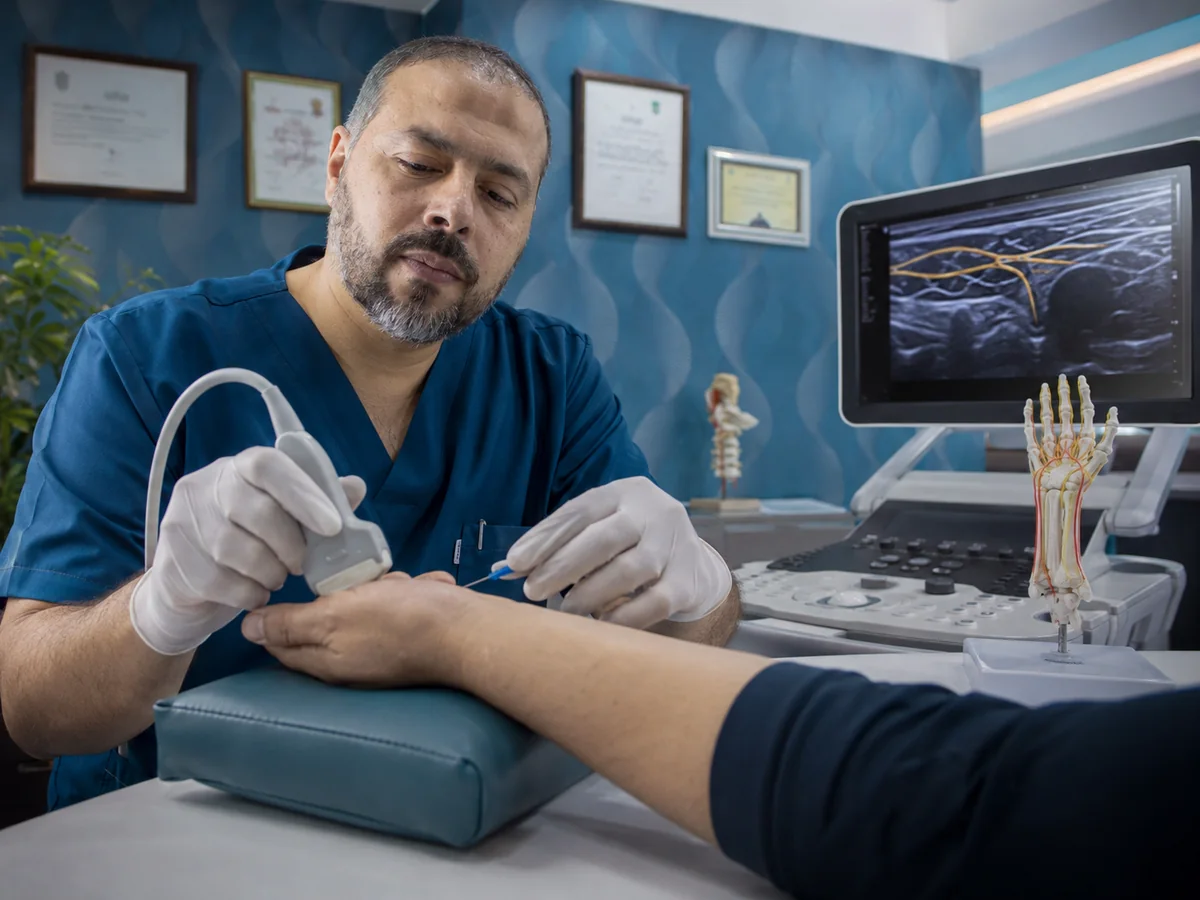
An injection given "by feel" in the spine may miss the intended nerve. Spinal injections are therefore performed under a mobile X-ray unit (fluoroscopy) that shows the vertebrae in real time, with a small amount of contrast to confirm the medication will spread in the right place. Peripheral nerve and some joint injections are guided by ultrasound, which shows the nerve and the vessels around it.
Image guidance means less medication with better effect, and more safety because the needle stays away from vessels and nerves that should not be touched.
Your procedure day, step by step
Most pain management procedures without surgery are done in one short session with no hospital stay. This is what usually happens:
Before the day
Your medications are reviewed, especially blood thinners and diabetes drugs, and you are told whether and when to pause any of them. Do not stop anything without clear instructions. Bring someone to take you home.
Preparation
You lie on your front or back depending on the target, the skin is cleaned and numbed, and light sedation is available if you are anxious.
The guided injection
It usually takes 15 to 30 minutes. You feel pressure or a brief sting, and possibly a moment of your familiar pain as the needle nears the source.
Observation and home
You rest briefly for monitoring, then go home the same day with written instructions and a contact number.
After the injection: when will I feel better?
In the first hours you may feel clear relief from the local anaesthetic; some pain can return for a day or two before the anti-inflammatory effect starts, usually within several days. After radiofrequency, soreness or burning at the site can last a few days before the pain improves gradually.
- Rest on the day, then resume walking and light activity from the next day.
- Do not drive that day if you were sedated or feel numb.
- Monitor your sugar if you are diabetic, since steroids can raise it temporarily.
- Start physiotherapy once the pain eases; it is what keeps the result going.
Call us or go to the emergency department if you notice: fever or redness and swelling at the injection site, a severe headache that worsens when sitting up, new weakness in a leg or arm, or loss of bladder or bowel control.
Who is not a candidate for non-surgical treatment?
Treating back and neck pain without surgery is an excellent option for many patients, yet in some situations it is postponed or another treatment is chosen:
- Progressive weakness in the foot or hand, or loss of bladder or bowel control: the nerve needs urgent surgical decompression.
- Active infection in the body or at the injection site.
- Uncontrolled bleeding tendency, or blood thinners that have not been safely paused.
- Pregnancy, because X-ray guidance is used.
- Spinal instability, fracture, tumour or bone infection, which need a different plan.
- Uncontrolled diabetes, until readings settle.
If the scan shows severe nerve compression with muscle weakness, or severe pain persists for several weeks despite proper treatment, Prof. El-Gaidi will explain spine surgery options such as endoscopic discectomy or decompression, and when they suit you better than more injections.
A spine surgeon who chooses between injection and operation
The advantage of having your pain treated by a professor of neurosurgery is that he knows both paths well: when an injection is enough, and when delaying surgery would harm the nerve. You will not be offered a procedure simply because it is available, nor pushed into an operation you can avoid.


The Spine Health & Neurosurgery Center is at 114 El-Tahrir St., Dokki, Giza, next to Dokki Metro station (4th floor), easy to reach from Mohandessin and central Cairo. Bring your MRI disc or link, older scans, your medication list and reports of any previous surgery or injections.